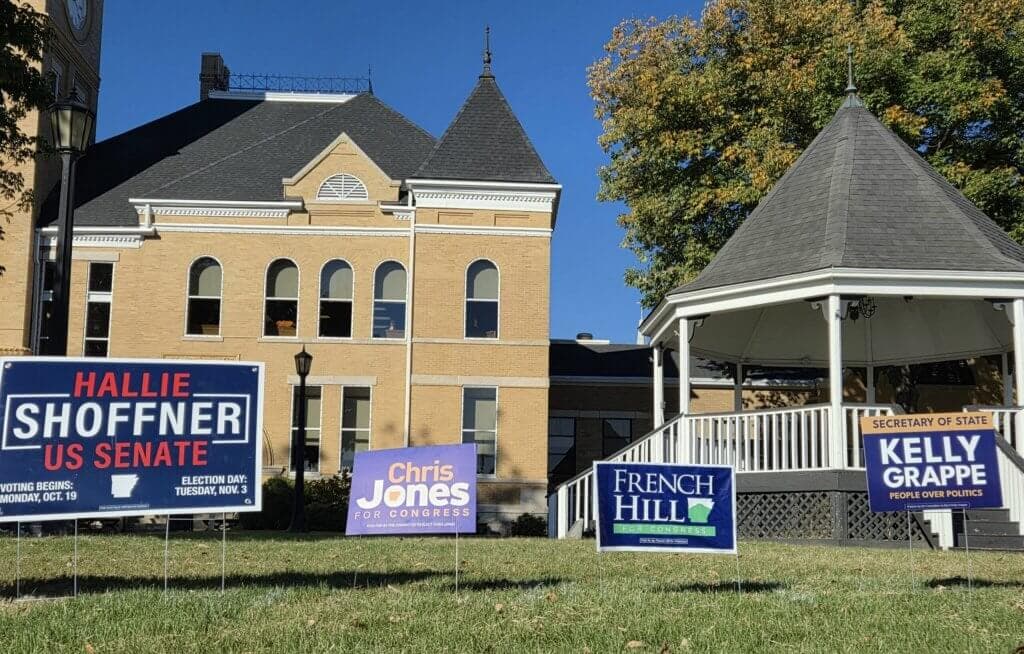
Saline County, a central Arkansas Republican stronghold for decades, saw a significant shift toward Democratic candidates in the 2026 midterm elections, with several races tightening in a region where the GOP has long dominated. The changes come amid growing voter concerns over economic issues and shifting demographics in parts of the county.
The county, located just southwest of the Democratic-leaning state capital of Little Rock, has not backed a Democratic presidential candidate since Bill Clinton’s 1996 reelection. Yet, in an election that saw Republicans face major setbacks nationwide, Saline County voters swung 17 percentage points toward Democratic candidates compared to the last midterm.
According to unofficial results, nearly 44,000 voters cast ballots in the county, with early voting participation reaching a record high of nearly 34,000, Saline County Clerk Doug Curtis noted on social media. By contrast, voter turnout during the 2024 presidential election surpassed 58,000.
While Republicans retained control over county offices and all legislative seats in the area, the party faced closer-than-expected races. State Rep. RJ Hawk (R-Bryant) narrowly defeated Democrat Gina Thomas-Littlejohn by just 96 votes in a district spanning the northeastern part of the county closest to Little Rock. Two years ago, Hawk prevailed over Thomas-Littlejohn by more than 2,300 votes.
Shane Broadway, chairman of the Saline County Economic Development Corporation and a former Democratic state legislator, attributed the leftward shift in part to economic concerns dominating voters’ minds. “Especially on the Democratic side, they were focusing on costs of gas, groceries, those kinds of things,” Broadway said, adding that he saw little discussion of former President Donald Trump during the campaign.
Republican U.S. Sen. Tom Cotton and U.S. Rep. French Hill both saw their vote shares drop in Saline County, despite past attempts by Democrats to link them to the controversial former president. State Sen. Kim Hammer (R-Benton), recently elected as Arkansas Secretary of State, suggested the shift might reflect a protest vote. “I think we’re going to see the pendulum swing back the other direction because people will realize we were going in the right direction,” Hammer said.
Democrats capitalized on frustrations about inflation and other economic issues, said Thomas-Littlejohn, who noted hearing from some voters who crossed party lines. “Some Republicans [said] they have voted Democrat this year. I’ve never heard that before,” she said.
Population changes in northeast Saline County, including cities like Bryant, Alexander, and Shannon Hills, may also be contributing to the trend. The area has drawn residents leaving Little Rock in search of a lower cost of living. This influx of new residents has diluted what some say was a historically reactionary Republican voter base. Lela Chism, a Democrat and newly elected Shannon Hills city council member, attributed part of the local results to evolving voter priorities. “The culture stuff might hype you up and get reactionary people out to the polls... but the policy itself isn’t popular,” she said.
Chism was a vocal opponent of an unsuccessful Republican-backed referendum to cut library funding in the county. She argued that the failure of such measures shows Saline County voters may favor policies over polarizing rhetoric, a sentiment echoed by first-time Democratic candidate Joshua Irby, who campaigned for Hammer’s former Senate seat. “People are just feeling like, ‘Where’s the help?’ Where are the people who are representing us, and what are they doing to improve this situation?” Irby said, after losing to Hammer’s Republican successor, Sheriff Rodney Wright.
Despite the results, former Arkansas Republican Party chair Richard Bearden urged caution. “I don’t know that we can look at one election cycle and say, ‘Golly, the state’s trending back to being the sort of yellow-dog Democrat state that it was 20 years ago,’” he said.
Democrats in Saline County have noted recent recruiting successes and point to enthusiasm they say is growing. Thomas-Littlejohn highlighted local efforts such as expanding Democratic headquarters and strengthening grassroots outreach. Still, Republicans firmly control all 13 Quorum Court seats and hold strong legislative majorities statewide.
Broadway predicted the challenges facing voters—including high costs of essential goods—would continue to shape electoral dynamics. “I’ve seen red waves, I’ve seen blue waves, and I’ve seen a lot of times where Arkansas was not a part of either,” he said, describing Arkansas voters as having an independent streak.
Chism, however, remains optimistic about the future of Democratic gains. “If the Republicans in Arkansas continue to neglect the needs of working people and average people, they’re going to lose again,” she said.
Saline County’s 2026 election trends offer a glimpse into the evolving political landscape of a state long regarded as a Republican stronghold.