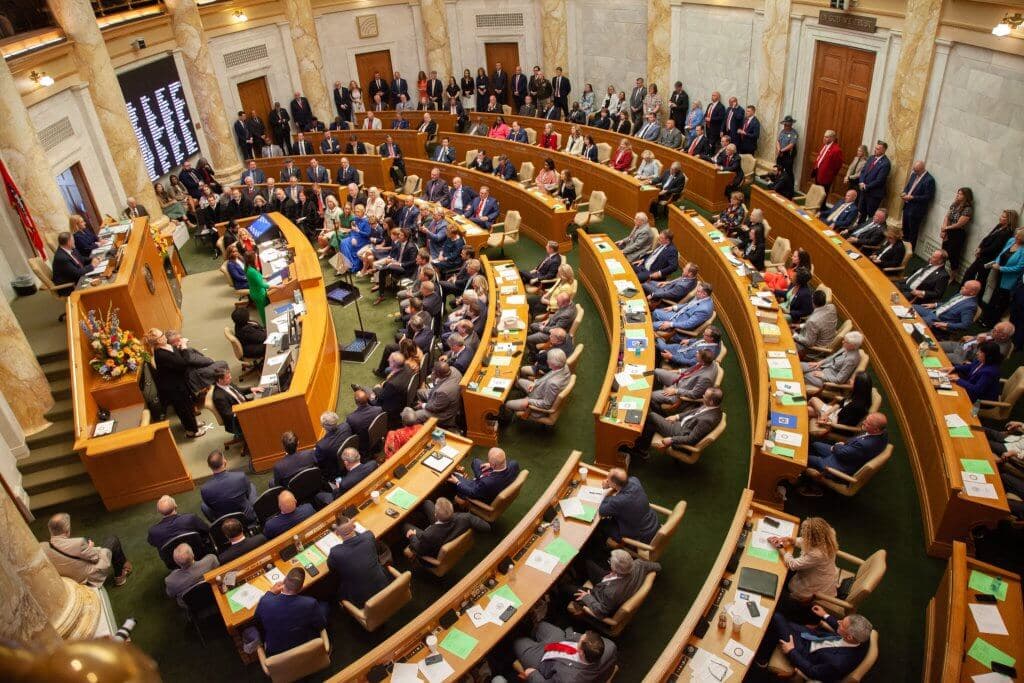
Democrats made unexpected gains in the Arkansas Legislature during the recent midterm elections, ending the long-held Republican supermajority in the state House of Representatives.
The party gained 10 seats in the 100-member House, giving Democrats a total of 30 seats. They also flipped a Republican seat in the Senate, though the GOP retains its supermajority in that 35-member chamber with 27 filled seats. Republicans hold majorities in both legislative bodies, but Democrats now have leverage in certain budget negotiations for the first time in ten years.
A legislative supermajority allows one party to pass high-threshold measures, such as most appropriations bills, without support from the opposing party. In Arkansas, appropriation bills require a three-fourths majority—75 votes in the House and 27 in the Senate. While everyday legislation often passes with a simple majority, the three-fourths rule can play a pivotal role in contentious budget talks, particularly regarding the state’s Medicaid expansion.
The return to a partisan balance in the House could change dynamics at the Capitol. Governor Sarah Huckabee Sanders and GOP lawmakers will now need Democratic cooperation to advance key appropriations, such as funding for programs like Arkansas’s hybrid Medicaid expansion plan. This program provides health coverage to over 200,000 low-income residents but has faced significant resistance within the Republican ranks. Appropriation bills for Medicaid faced multiple failures in earlier years, leading former Governor Asa Hutchinson and legislative leaders to use procedural maneuvers to ensure the program’s continuation.
Beyond Medicaid, the Democrats’ gains could influence other funding-related debates. Discussions over Governor Sanders’ plan for a 3,000-bed prison, which was halted due to legislative opposition, and debates about funding the governor’s school voucher program may now require greater bipartisan negotiations.
The Arkansas Senate remains controlled by Republicans, but Democrats hold seven seats, effectively preventing Republicans from passing three-fourths majority bills without crossover votes. A special election scheduled for December 15 will fill a vacant Senate seat left by the resignation of former Republican Senator Jonathan Dismang.
Democratic House Minority Leader Andrew Collins has expressed hope that the gains will allow the party to influence policy while still finding bipartisan solutions. Similarly, Governor Sanders has cited past bills with cross-party support, including measures on free school breakfasts and banning cellphone use in schools, as evidence of potential collaboration in the upcoming session.
While more contentious budget battles may emerge, non-budget legislation—which requires only a simple majority—will likely remain unaffected by the shift in House representation. As lawmakers prepare for the next session, how both parties navigate the new power dynamic could shape critical programs and priorities for the state’s future.