Debates over data centers have become a significant issue in local elections across Arkansas, with community concerns about energy consumption, water usage, and potential benefits prompting opposition to their construction. However, the topic has yet to make a notable impact in high-profile races for state and federal offices.
Polling conducted in August by Talk Business & Politics and Hendrix College revealed strong resistance to data centers among likely voters in Arkansas’s 2nd Congressional District. Over half of respondents expressed strong opposition to having a data center in their community, with an additional 19% somewhat opposed. The poll, which surveyed voter sentiment amid rapid growth in data center construction nationwide, reported a margin of error of ±4.7 percentage points.
The backlash at the community level reflects a broader struggle playing out nationally as technology companies race to develop artificial intelligence systems reliant on vast data storage and processing facilities. Critics in Arkansas have questioned the promises of job creation and tax revenue often associated with these projects, coupled with concerns over energy demands and water usage.
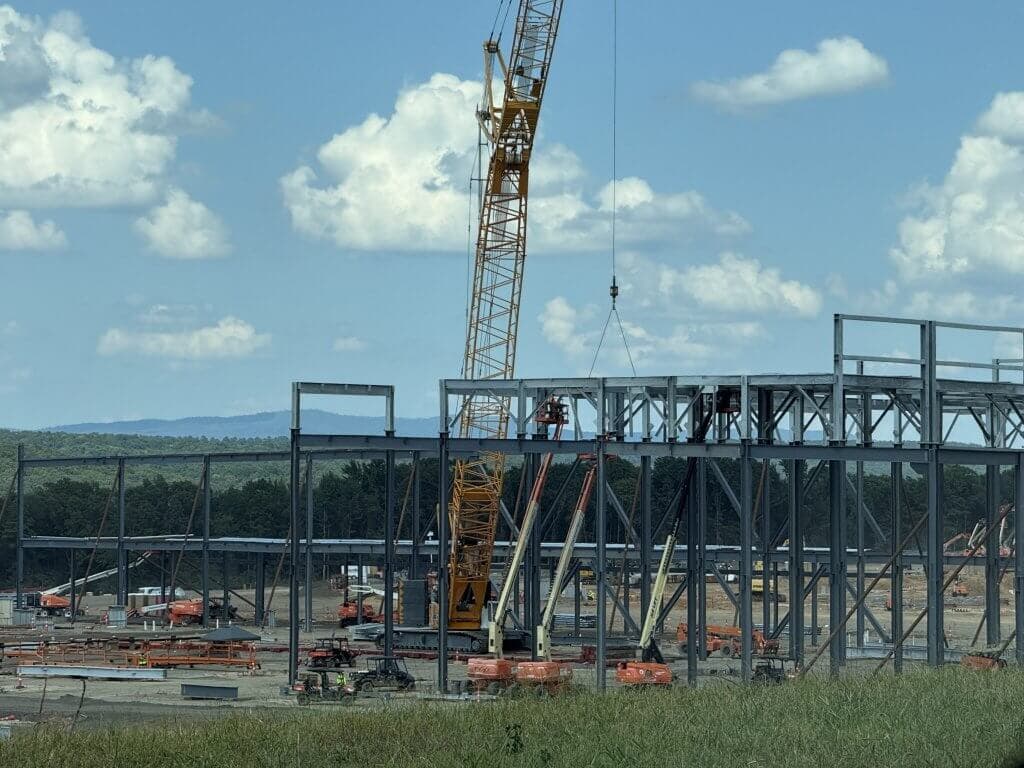
In Clarksville, a $6.6 billion data center project has become a campaign issue for independent legislative candidate Debra Hobbs, a former Republican state representative. Hobbs has criticized tax incentives granted for the facility. Her opponent, incumbent Republican Rep. Aaron Pilkington of Knoxville, has defended such projects. Pilkington is also the executive director of the Arkansas Connected Communities Association, a nonprofit advocating for data centers and artificial intelligence.
Similarly, in Pulaski County, Wendell Griffen—a former circuit and appeals court judge and the Democratic nominee for the county judge’s office—pushed for new land-use regulations targeting data centers. The measures were driven by community frustration with plans to build a new facility in the area. Griffen emerged as a leading advocate for the regulations, speaking at length during public meetings and promoting his stance on social media. His opponent, Republican Michael Rushin, has criticized the regulations, arguing they could lead to costly litigation. Shortly after the regulations passed, the county was sued.
In Conway, discontent over a proposed data center has fueled calls to remove certain city council members. And in Little Rock, surveillance technology tied to artificial intelligence has surfaced as a campaign topic in the mayoral race, with opposition highlighting concerns about privacy and governmental oversight.
Despite the local tensions, data centers have not emerged as a dominant issue in statewide or federal contests. Jay Barth, professor emeritus of politics at Hendrix College, noted that limited Democratic campaign funding might explain the absence of broader engagement with the topic. “If there had been more expansive campaigns, this issue might have gained more prominence,” Barth said.
Efforts to facilitate data center development at the state and federal levels have continued. Republican U.S. Sen. Tom Cotton has proposed a measure, the DATA Act, aimed at enabling data centers to generate their own power. The legislation, he argued, addresses some public criticisms. Similarly, Republican Governor Sarah Huckabee Sanders has voiced support for data centers while defending Arkansas’s existing AI regulations.
Still, skepticism persists. State Sen. Fred Love, a Democratic challenger to Sanders, sought a non-binding resolution in August to encourage a temporary moratorium on new data center projects. Meanwhile, public utility policies—including mechanisms allowing ratepayers to fund new power generation projects for data centers—have fueled additional frustration among some Arkansas residents.
Barth suggested that legislation regulating local control and addressing these funding mechanisms could dominate policy discussions in the upcoming legislative session. "It’s going to be a pivotal battle," he said, pointing to parallels with debates over education funding and the state’s school voucher program.
Although the debate over data centers remains primarily local, its trajectory is distinctly tied to statewide regulatory decisions and the evolving demands of major technology industries.