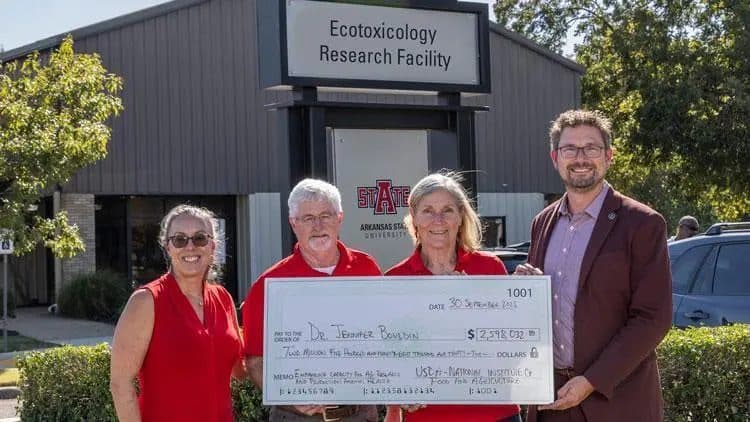
JONESBORO, Ark. — Arkansas State University (A-State) has announced a $2.6 million project to expand its animal health and agricultural research facilities, with $1.3 million funded by the U.S. Department of Agriculture’s National Institute of Food and Agriculture. According to the university, construction began in September and is expected to be completed by 2030.
The initiative includes the development of new research space on the university farm and the installation of advanced equipment at the Ecotoxicology Research Facility. These enhancements aim to consolidate diagnostic and analytical capabilities on one campus, supporting research for the Mississippi River Delta region.
The university is one of 36 institutions nationwide to receive funding through the USDA’s research facilities program. This expansion will bolster the College of Veterinary Medicine's research efforts and strengthen the animal science curriculum within the College of Agriculture.
Jennifer Bouldin, dean of the Beck College of Sciences and Mathematics, highlighted the collaborative potential of the project, saying, “This grant provides an exciting opportunity for the Beck College of Sciences and Mathematics, the College of Agriculture, and the College of Veterinary Medicine to collaborate on innovative research initiatives both within and across the three colleges.”
The project includes equipment upgrades at the Ecotoxicology Research Facility, which operates within the Beck College of Sciences and Mathematics. These upgrades will improve research into animal feed quality, an essential component of large-animal studies. Expanded testing capabilities will allow researchers to analyze organic contaminants, metals, and nutrients, offering more cost-efficient in-house analysis for agriculture and veterinary medicine research.
Officials said the new facilities and equipment would also expand opportunities for students. Bouldin noted that improved resources will provide graduate and undergraduate students with more chances to engage in hands-on research projects that advance their fields.
“The combination of federal investment, university funds, and commitments from donors are critical for growing the research capacity through improved facilities at A-State,” said Travis Marsico, vice provost for research, innovation, and discovery. Marsico also commended Bouldin and her team for preparing the grant proposal on a tight timeline, with strong support from the university’s leadership.
A-State officials said the ability to analyze feed for essential nutrients will enable researchers to gain deeper insights into large-animal health. Additionally, the partnership aims to serve the region’s industries and agricultural community more effectively by addressing practical challenges through collaborative research.
Construction on this multi-year project strengthens A-State's role as a regional research hub for animal health and agricultural sciences.