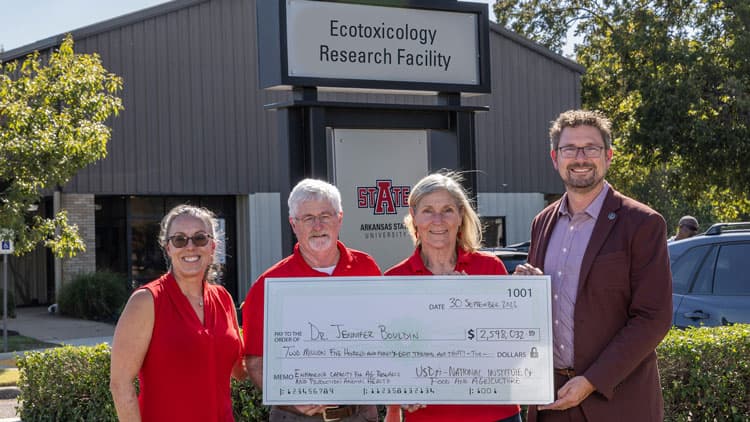
Researchers at Arkansas State University (A-State) have secured a $2.6 million grant to bolster agricultural research and improve animal health within the Mississippi River Delta. Announced Monday, the project includes $1.3 million in funding from the National Institute of Food and Agriculture, part of the U.S. Department of Agriculture, with the remaining funds coming from other sources.
A-State is one of 36 universities nationwide to receive funding through this effort, which supports research infrastructure. Given the prominence of agriculture in northeast Arkansas, this initiative is expected to improve diagnostic and analytical capabilities, strengthen research operations, and reduce costs by centralizing resources on campus.
The project commenced in September and has a target completion date of 2030. Planned developments include constructing a dedicated research space at A-State’s university farm to benefit the College of Veterinary Medicine (CVM) and enhance the animal science curriculum in the College of Agriculture (CoA). Additional investments will fund new equipment in the Ecotoxicology Research Facility, part of the Beck College of Sciences and Mathematics, to facilitate studies of animal feed quality—a key factor in large-animal health care.
Dr. Jennifer Bouldin, dean of the Beck College of Sciences and Mathematics, emphasized the collaborative benefits of the initiative. “This grant provides an exciting opportunity for the Beck College of Sciences and Mathematics, the CoA, and the CVM to collaborate on innovative research initiatives both within and across the three colleges,” Bouldin said.
Increased analytical capacities will allow researchers to test for organic contaminants, metals, and nutrients on-site. This capability will not only expand research potential but also provide cost savings by eliminating the need to outsource such analyses.
The new facilities and equipment are also expected to enrich student opportunities. Graduate and undergraduate students will gain hands-on research experience, contributing to projects that have practical applications in agriculture, veterinary medicine, and animal science. “With expanded facilities and access to new equipment, students across the three colleges will have increased opportunities to engage in innovative research projects, gain hands-on experience, and contribute to discoveries that advance their respective fields,” Bouldin added.
Dr. Travis Marsico, vice provost for research, innovation, and discovery at A-State, highlighted the importance of federal and institutional collaboration in achieving this milestone. “The combination of federal investment, university funds, and commitments from donors are critical for growing the research capacity through improved facilities at A-State,” Marsico said. He credited A-State’s leadership and faculty, noting the tight deadlines involved in the grant application process.
The project’s overarching goal is to support regional agriculture by improving the quality of animal feed, which directly impacts herd health and, by extension, rural economic vitality. By fostering partnerships with industry stakeholders and agricultural communities, A-State aims to strengthen the region’s economy and address real-world challenges. “This partnership will expand A-State’s ability to serve the region’s industries, the agricultural community, and other stakeholders by fostering collaborative research and addressing real-world challenges,” Bouldin said.
The initiative underscores Arkansas State University’s commitment to advancing research and education while contributing to the agricultural and economic development of northeast Arkansas.