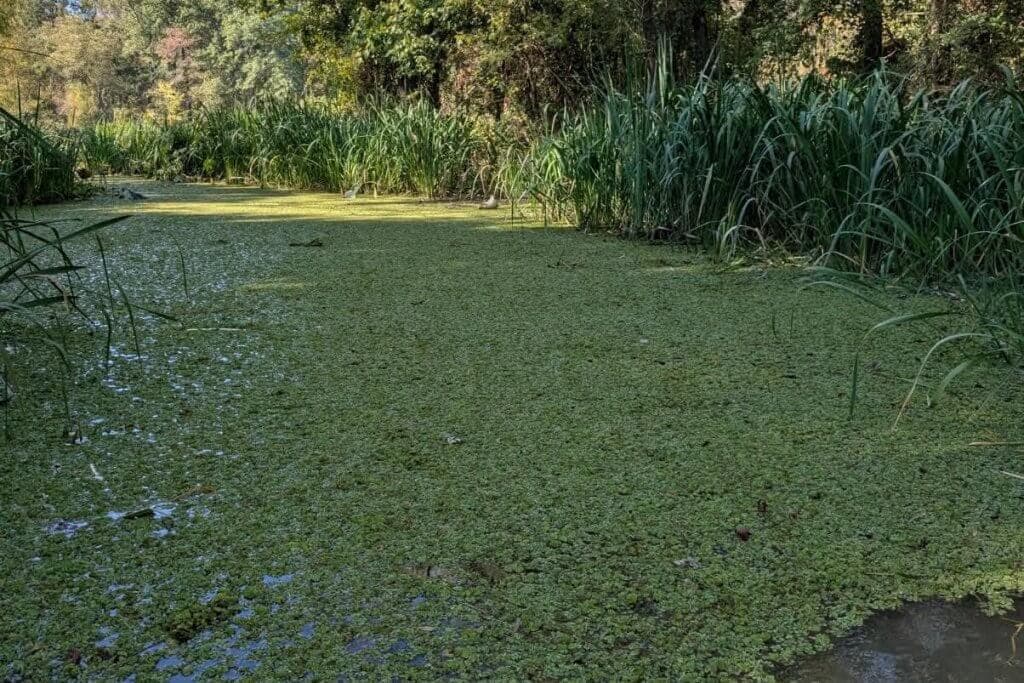
Crews from the Arkansas Game and Fish Commission (AGFC) and the U.S. Army Corps of Engineers (USACE) are responding to the discovery of giant salvinia, an invasive aquatic plant, in a tributary feeding into Millwood Lake. The plant was identified near the White Cliffs Public Use Area on the Little River.
The rapid response began Friday after a local angler spotted the plant and reported it to state officials. AGFC’s Aquatic Nuisance Species Coordinator Matt Horton stated that a containment team quickly assessed the site and began efforts to prevent the plant from spreading. Initially, containment booms were installed around a 300-foot section of shoreline near the White Cliffs Campground, where the infestation is believed to have originated. However, further surveys revealed the plant had already spread, prompting crews to extend the containment area to 1,900 feet of shoreline.
“Even a small fragment of giant salvinia can regrow and survive. With such dense shoreline vegetation along the Little River, fragments can easily remain hidden,” Horton said.
Throughout the weekend, AGFC and USACE personnel worked together to physically remove more than 900 pounds of salvinia from the infested area. Crews also discovered fragments up to a mile upstream and downstream of the campground. Efforts to address the spread are ongoing, Horton added.
In the coming days, teams from AGFC will begin applying an EPA-approved aquatic herbicide to target visible patches of salvinia and reduce shoreline vegetation that could harbor the plant. Once the vegetation dies, authorities plan to conduct a controlled burn to eliminate remaining fragments trapped in plant mats.
Tiffany Smith, USACE’s Millwood Lake Operations Project Manager, emphasized the importance of collaboration in combating the infestation. “We’re grateful for the quick response and partnership with AGFC,” Smith said. “If left unchecked, giant salvinia poses a threat to Millwood Lake’s fisheries, recreation opportunities, and water supply.”
Officials are also calling on boaters and anglers to assist in preventing the spread. They ask outdoor enthusiasts to avoid disturbing the floating containment booms and to report sightings of giant salvinia to the AGFC Southwest Regional Office at 501-255-1496, by emailing katie.thomsen@agfc.ar.gov, or through the AGFC website.
This is not the first time giant salvinia has been discovered at Millwood Lake. The plant was eradicated there in 2020 following similarly swift intervention. However, Horton warned that continued vigilance is required. “We were able to stop it back then because of early detection and immediate action, and we hope to do the same this time. But we need the public’s help,” he said.
Currently, the AGFC is also addressing infestations in two other south Arkansas lakes — Lake Columbia and Lake Erling. Horton noted that the plant has become a costly challenge for neighboring states like Texas and Louisiana, which spend millions annually attempting to manage the invasive species.
To help prevent the spread of aquatic nuisance species, the AGFC urges boaters and waterfowl hunters to follow these guidelines:
- **Clean:** Inspect and remove all visible mud, plants, and seeds from trucks, boats, trailers, waders, decoys, and other equipment. Use a high-pressure sprayer for thorough cleaning. - **Drain:** Pull all drain plugs, livewell valves, and bilge lines before leaving the boat ramp area. - **Dry:** Let all gear dry completely for at least five days before using it in another body of water. If this is not feasible, thoroughly dry all wet surfaces with towels.
Officials remain hopeful that immediate response efforts will help contain the infestation and protect Millwood Lake’s resources for future uses.