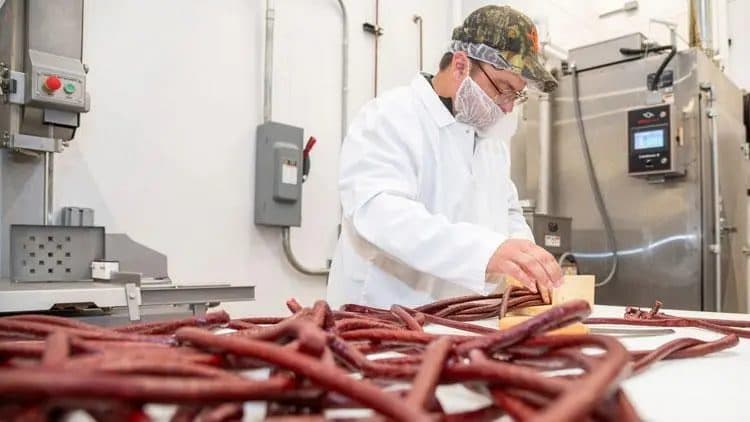
JONESBORO, Ark. — Arkansas State University (A-State) will host a dedication ceremony on Wednesday, Oct. 28, to mark the completion of $750,000 in upgrades to its meat lab. The renovations are aimed at expanding snack stick production and enhancing student training with commercial meat-processing equipment.
The event, set to begin at 10 a.m., will take place at the Judd Hill Farmers’ Market. A tour of the meat lab, located in Room 131 of the College of Agriculture, will follow the ceremony.
The project was made possible by a grant from the Arkansas Office of Skills Development. The funding covered the cost of new equipment, a new roof, and significant refrigeration updates.
Since fall 2023, the lab has partnered with Arkansas Hunters Feeding the Hungry (AHFH) to produce snack sticks for weekend backpack programs in schools across the state. According to the university, these programs currently serve 70 schools in 48 Arkansas counties. Students enrolled in the College of Agriculture are directly involved in the meat lab’s operations, gaining hands-on experience with professional-grade processing and packaging equipment.
“We will have key speakers regarding the Arkansas Hunters Feeding the Hungry (AHFH) snack stick program and their partnership with A-State,” said meat lab director Corey Readnour.
Newly installed equipment includes a roll stock vacuum packaging machine, a snack stick cutting machine, a vacuum stuffer, a meat grinder, and a meat mixer. Readnour explained that the upgrades are designed to implement a high-speed production line and give students access to advanced, industry-standard tools.
“These upgrades were to implement a high-speed snack stick line and train students on updated, state-of-the-art equipment that you would find in a commercial operation,” Readnour said.
While waiting for the new equipment to be installed, Readnour and his team focused on optimizing the production process and refining their product. Now fully equipped, the lab is ready for large-scale snack stick production, a step that Readnour believes will allow the program to reach more children throughout Arkansas.
“We have been working on fine-tuning the process and product development while waiting for the new equipment to be installed. Now we are ready to launch large-scale production,” said Readnour.