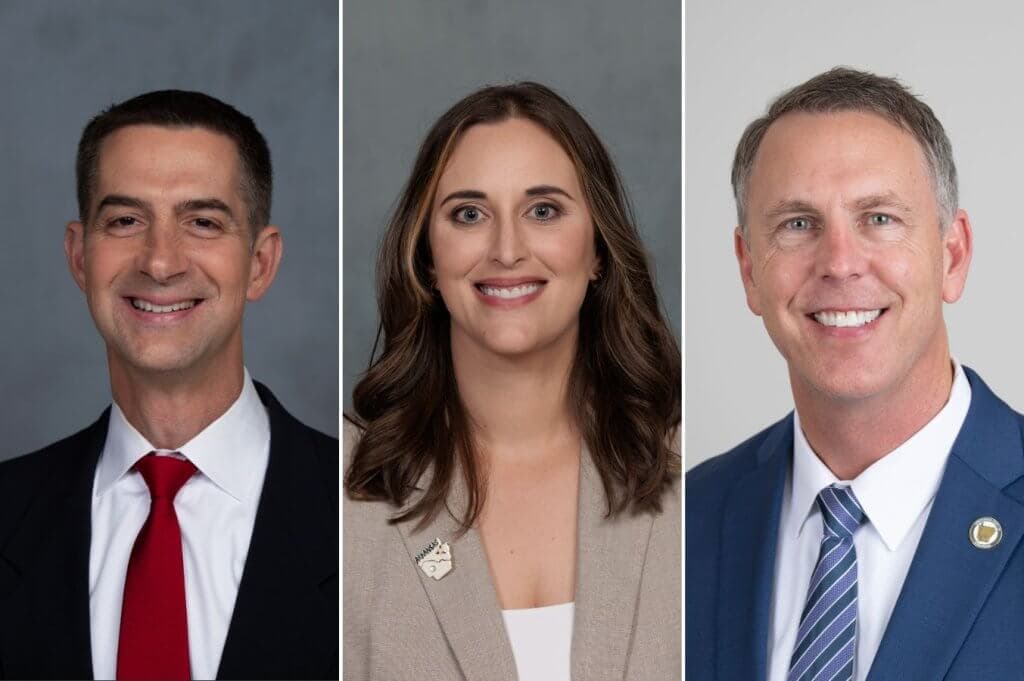
Senator Tom Cotton, seeking a third term to represent Arkansas in the U.S. Senate, faces criticism from his challengers, Democrat Hallie Shoffner and Libertarian Jeff Wadlin, who argue that he has neglected state issues in favor of a high-profile role in Washington. Cotton, an influential Republican and chairman of the Senate Intelligence Committee, boasts a record of tax cuts, military support, and tighter border security, but his opponents claim Arkansas's pressing concerns have taken a back seat.
Both Shoffner and Wadlin have accused Cotton of being inaccessible, pointing to his refusal to participate in debates as indicative of a broader absence. "My personal opinion is that he’s a coward," Wadlin said. Shoffner echoed the sentiment, citing Cotton’s lack of town halls in nearly a decade. While Cotton had initially agreed to a debate with Shoffner hosted by Salem Media Group, the invitation was later retracted by the organizer, reportedly over exclusive terms.
Shoffner's campaign has hinged on addressing local economic concerns, including rising costs in gas and groceries, underscoring what she calls a disconnect between Cotton and everyday Arkansans. Her recent comments on immigration, highlighted in a Cotton-sponsored ad, have drawn scrutiny. Shoffner, who closed her family farm last year due to financial hardship, contends her remarks were taken out of context. "Tom Cotton is going to clip up everything that I say," she said, labeling it a tactic to avoid open discussions.
Libertarian candidate Wadlin said his grassroots campaign reflects growing frustration among center-right voters with Cotton’s leadership. "I get this heterogenous mix of people who are independents, Libertarians, and disengaged voters who otherwise wouldn’t vote at all," he said, emphasizing a need for pragmatic solutions to healthcare and economic disparity.
On healthcare, Shoffner has highlighted concerns about Medicaid and Medicare, noting a looming reduction in federal healthcare funding and the Trump administration’s denial of an extension for Arkansas’s expanded Medicaid program. Wadlin proposed a healthcare restructuring that balances public and private partnerships, though he acknowledged it was "not the most Libertarian solution.” Cotton has supported federal tax reforms that will reduce spending on Medicaid, a program relied on by over 800,000 Arkansans.
Agricultural issues have also featured prominently in the campaign. Shoffner criticized Cotton’s votes against recent versions of the Farm Bill, which funds vital farming and food assistance programs. Cotton has justified those votes by opposing high allocations for food aid programs like SNAP. Shoffner has contrasted her stance, advocating for consistent support for farmers and smaller-scale reform to avoid disruptions. Cotton has pushed for tariffs to counter international subsidies affecting Arkansas rice farmers but has otherwise aligned closely with former President Donald Trump’s broader trade policies, which Shoffner and Wadlin have criticized for harming local agriculture.
Wadlin and Shoffner also disagree with Cotton on foreign policy issues, including his support for the ongoing war in Iran. The conflict has contributed to spikes in gas and fertilizer prices, which Shoffner said have energized support for her campaign. “People walk up to me feeling a lot of anxiety, and they’re ready for something different,” she noted.
Republicans have maintained a dominant grip on Arkansas politics for a decade. Despite this, a Hendrix College and Talk Business & Politics poll in August showed a narrower-than-expected gap between Cotton and Shoffner, though Cotton widened his lead in subsequent surveys. Cotton's campaign, along with aligned groups, has vastly outspent competitors, with heavy funding from America One, a conservative super PAC. Early voting for the November 7 election is already underway, with Democrats viewing the race as a rare opportunity for competition in a reliably Republican state.