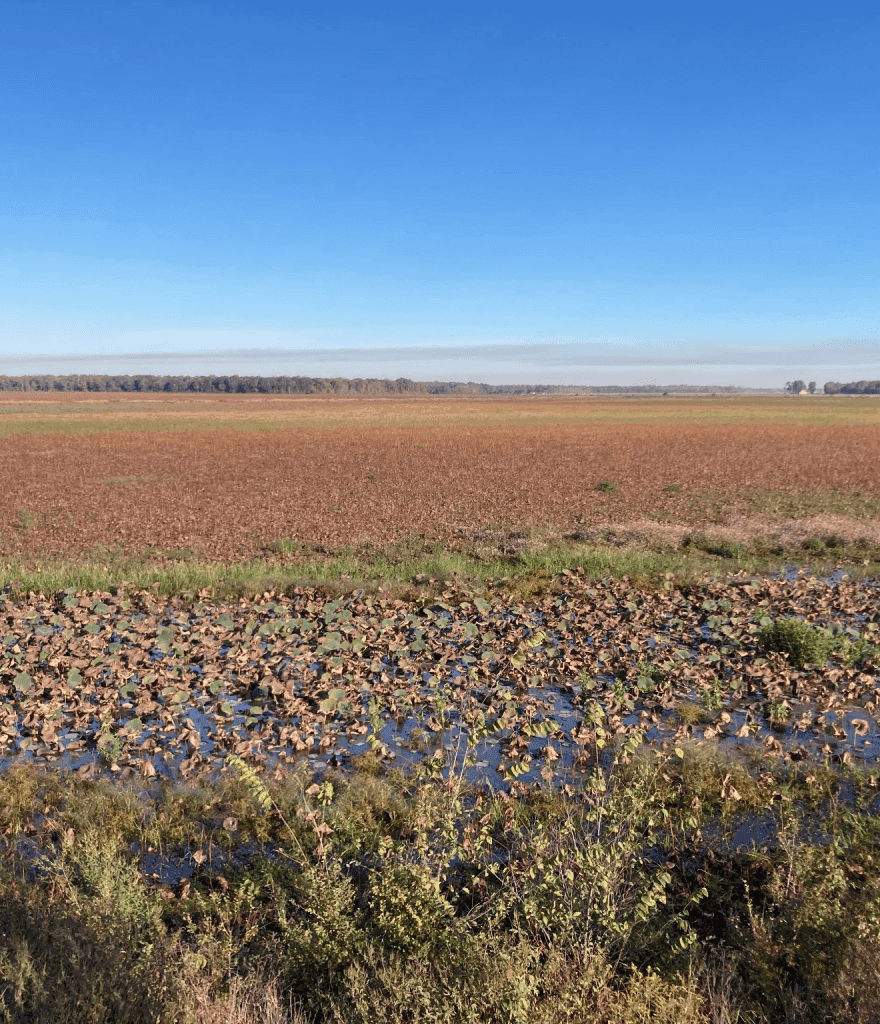
Fourteen months of persistent drought have significantly impacted Arkansas’s wetlands, raising concerns for waterfowl hunters as the first segment of duck season approaches on Nov. 21. Arkansas Game and Fish Commission (AGFC) Director Doug Schoenrock advised commissioners and hunters on Oct. 7 to prepare for dry conditions on both public and private hunting lands.
“Much of Arkansas is more than 20 inches behind in cumulative rainfall totals. That sort of deficit doesn’t disappear after a few 1-inch rains,” Schoenrock said during an AGFC committee meeting in Little Rock. He emphasized that hunters should lower expectations as the drought continues to constrain water resources critical for flooding wetlands that support waterfowl habitat.
### Dry Conditions Impact Wetland Coverage
According to David Luker, AGFC assistant chief of wildlife management, only 42% of the moist-soil units managed by the agency had sufficient water as of early October. Jeffrey Cothren, coordinator for AGFC’s Wetland Habitat Program, revealed that 71 units currently amounting to 4,627 acres can be flooded. However, only 42 huntable moist-soil units, covering 3,553 acres, are realistically accessible, with 2,020 acres of that total located at the Steve N. Wilson Raft Creek Wildlife Management Area.
“Even with nonstop pumping from the White River, the best-case scenario for Raft Creek is to have 34 permit hunt locations available by Christmas,” Cothren said. He noted that AGFC staff have worked to create high-quality moist-soil vegetation, but the lack of water endangers their ability to provide habitat for migrating ducks.
Key lakes feeding greentree reservoirs, such as Lake Charles and Harris Brake Lake, have also been severely affected. Lake Charles, currently over 8 feet below its normal pool, cannot provide enough water to flood the Shirey Bay Rainey Brake reservoirs without collapsing its fishery. Similarly, decisions to conserve water at Harris Brake Lake mean that insufficient resources are available to flood surrounding areas.
### Limits to Pumping
Some hunters have questioned why the AGFC does not rely solely on pumps to fill wetland areas. Luker explained that roughly 95% of the AGFC’s artificially flooded wetlands depend on rainfall and surface water. River, stream, and canal-fed systems have diminished due to the extended drought, limiting the utility of pumps. Groundwater pumping, even on a small scale, is not a viable long-term solution due to the high volume of water needed and potential consequences for water tables.
“We’ve run pumps on Lake Ashbaugh for 16 months straight, and the lake levels remain critically low due to evaporation and seepage,” Schoenrock said, emphasizing the unsustainability of relying on groundwater during a drought of this magnitude.
### Broader Issues Among Private Lands
Private landowners and hunting clubs are also struggling. AGFC’s Waterfowl Rice Incentive Conservation Enhancement (WRICE) program, which provides habitat on private lands, faces major hurdles. Of the 4,569 enrolled acres, only 100 Wetland Reserve Easement acres can currently be flooded.
“Farmers are digging deep and still finding dry soil,” Luker said, highlighting the regional water scarcity. Reduced rice acreage across the state has further compounded the issue, as fewer flooded rice fields are available to sustain waterfowl during migration.
### Outlook for the Season
Luke Naylor, AGFC’s chief of wildlife management, noted that the state’s reliance on rice fields as a key component of waterfowl diets has created additional challenges. While public lands are prepared with native vegetation and alternative food sources, winter rains are essential to boost habitat and hunting conditions statewide.
Hunters and conservationists can monitor wetland conditions and operational updates through AGFC’s website at www.agfc.com/wetlandmanagement. Additional information on the WRICE program and its available hunt locations can be found at https://www.agfc.com/education/arkansas-waterfowl-rice-program-wrice/. Assessments for flooding adequacy will be made weekly for the 2026-27 season.