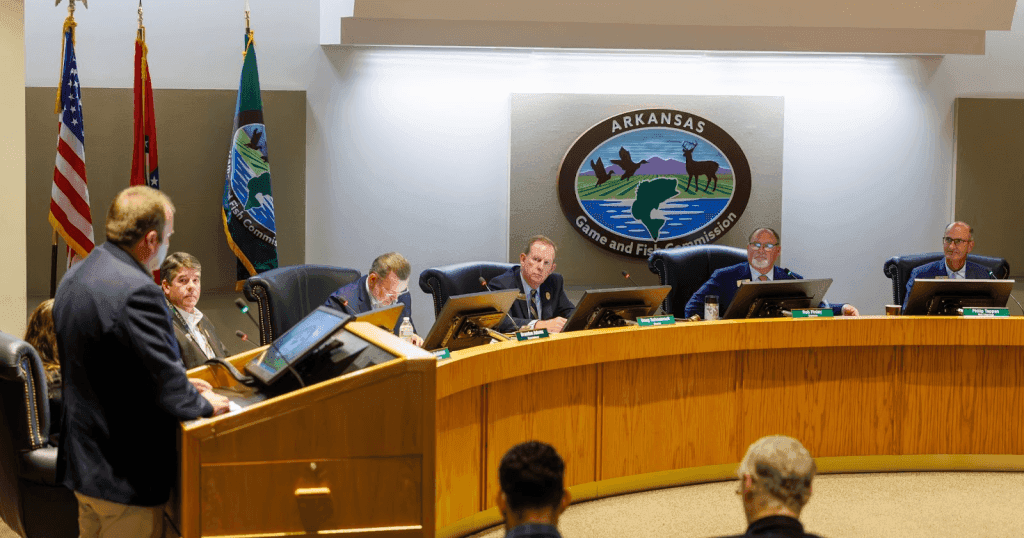
The Arkansas Game and Fish Commission (AGFC) has unanimously approved a resolution urging the Arkansas Department of Agriculture’s Natural Resources Division to prioritize design and construction of hydrology improvements for Little Bayou Meto as part of the broader Bayou Meto Water Management Project. The request aims to elevate the priority of these improvements in the department’s regular funding requests to the Army Corps of Engineers.
The Bayou Meto Water Management Project, originally authorized under the Flood Control Act of 1950 and reauthorized in 1996, focuses on three primary goals: providing an agricultural water supply, protecting aquifers from groundwater depletion, and maintaining wetland habitats critical to Arkansas’s waterfowl. Within this framework, the Little Bayou Meto drainage effort plays a key role in removing excess floodwater to sustain wildlife habitats.
David Luker, AGFC assistant chief of wildlife, emphasized the importance of water management in the George H. Dunklin Jr. Bayou Meto Wildlife Management Area (WMA). “Holding water to provide waterfowl habitat and hunting opportunity was the focus of this area for decades, but we’ve learned over the years that removal of that water during the growing season is even more critical to those trees that mallards and other ducks need during their migration,” Luker said during the Commission’s meeting.
The resolution highlights a need to coordinate with downstream landowners and drainage districts to clean out the Little Bayou Meto, improving water flow from the WMA to a pump station in Reydell. While pumping stations have been constructed in parts of the broader project, the AGFC sees downstream channel improvement as essential to the effort's success.
In addition to its vote on Bayou Meto, the Commission received an update on Arkansas’s alligator program from AGFC herpetologist Amanda Bryant, who noted continued progress on research and population management. Out of 212 available alligator hunting tags this year, 197 were filled, with private land hunters exceeding their quota by one alligator and public land hunters achieving a 64% harvest rate. Public land hunters accounted for 28 alligators harvested, while private hunters harvested 169.
Bryant also shared updates on a tagging and recapture study conducted in partnership with Clemson University. AGFC staff assisted in capturing and recording data on 76 alligators before the 2026 hunting season. The study focuses on verifying spotlight survey data and tracking alligator growth through recapture reports and harvested tags. Bryant noted the effort also provided valuable training for AGFC fisheries staff in alligator handling.
AGFC Director Doug Schoenrock used his monthly report to highlight several presentations from the meeting, which addressed issues such as drought impacts and the upcoming waterfowl season. Schoenrock also noted the positive outcome of this year’s bear hunting season.
The Commission further recognized employees for their contributions to conservation efforts. Ashley Turley, an administrative specialist; Michael Gilbert, a geospatial programmer; and Clint Johnson, the quail program coordinator, received this year’s Campbell Awards, which honor employees demonstrating professional excellence and a community-centered approach. Additionally, 25 AGFC employees were acknowledged for more than 260 combined years of service.
In other actions, the Commission approved:
- The transfer of an outdated Evinrude outboard motor, valued at $3,400, to the Ashley County Office of Emergency Management for search and rescue use. - The granting of a right-of-way easement to Entergy for an existing transmission line at St. Francis Sunken Lands WMA. - Formal election of all AGFC game wardens and staff as employees under existing personnel policies.
A video of the meeting is available on the AGFC’s YouTube channel.