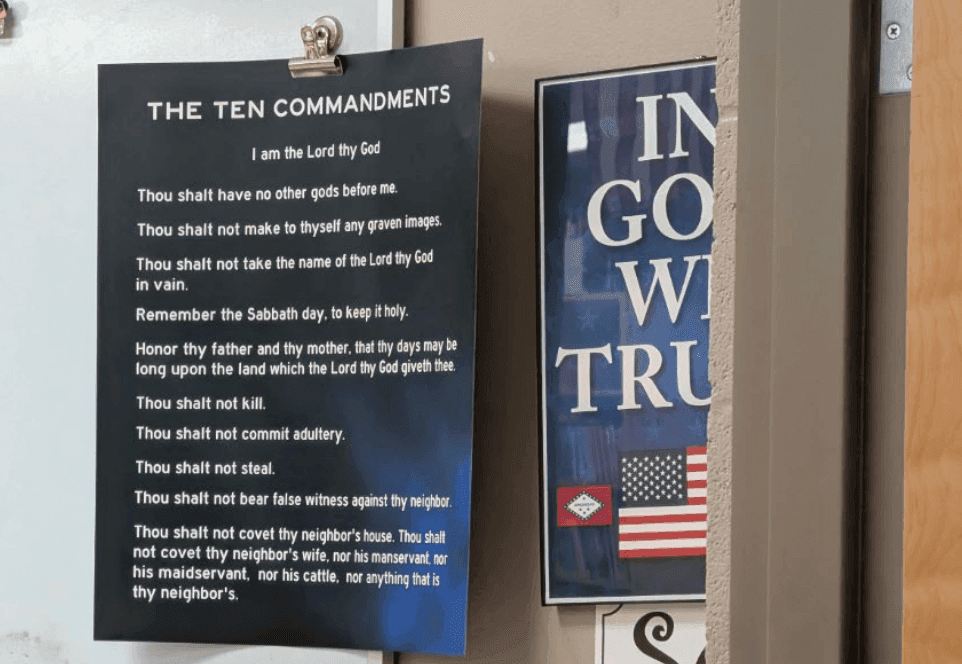
A federal appeals court is reviewing arguments over an Arkansas law mandating the display of the Ten Commandments in public school classrooms, libraries, and other taxpayer-funded institutions. The case, involving six school districts and ten families, centers on Act 573 of 2025, which requires such displays as a "historical representation."
The 8th U.S. Circuit Court of Appeals, meeting in St. Louis on Tuesday, heard oral arguments on whether to overturn a March ruling by U.S. District Judge Timothy Brooks. Brooks had declared Act 573 unconstitutional and blocked its enforcement in the Bentonville, Conway, Fayetteville, Lakeside (Garland County), Siloam Springs, and Springdale school districts. His decision cited violations of the First Amendment rights of families with varying religious and nonreligious backgrounds.
Autumn Hamit Patterson, solicitor general for the Arkansas attorney general’s office, argued that the lower court ruling was flawed. She contended the original seven plaintiffs lacked standing because their claims relied on speculative harm, such as future donations and display of Ten Commandments posters at their schools. Although displays were later hung in classrooms attended by children from three additional plaintiff families who joined the lawsuit, Patterson maintained the law was not coercive and did not burden religious freedom. She emphasized that Act 573 does not mandate curriculum changes or compel anyone to interact with the displays.
“There’s no requirement for teachers, school officials, or students to interact with, bring attention to, or even acknowledge the posters in any way,” Patterson told Judges Bobby E. Shepherd, L. Steven Grasz, and David R. Stras. Shepherd, appointed by George W. Bush, and Grasz and Stras, appointed by Donald Trump, presided over the case.
Jonathan Youngwood, an attorney representing the plaintiffs, countered that the law imposes a specific religious viewpoint, highlighting that the mandated displays reflect a Judeo-Christian interpretation of the Ten Commandments. “This is instruction. These are, after all, commandments, and they are directly religious,” Youngwood said, arguing that the displays conflict with some families' beliefs, including those of an atheist family and others practicing faiths with multiple deities.
The judges noted that challenges under the Free Exercise Clause often examine limitations on religious practices, but this case involves the promotion of religious content. They asked about maintaining neutrality in this context. Youngwood emphasized that the law undermines neutrality by imposing religious directives in classrooms.
Similar laws in Texas and Louisiana have faced legal challenges, and rulings earlier this year by the 5th U.S. Circuit Court of Appeals allowed both to take effect. Efforts are underway to escalate those cases to the U.S. Supreme Court. Meanwhile, the Alabama Legislature recently approved a similar law, effective October 1, requiring Ten Commandments displays in its schools.
The court did not indicate when a ruling on the Arkansas case would be issued, stating only that a decision would come "as soon as possible."