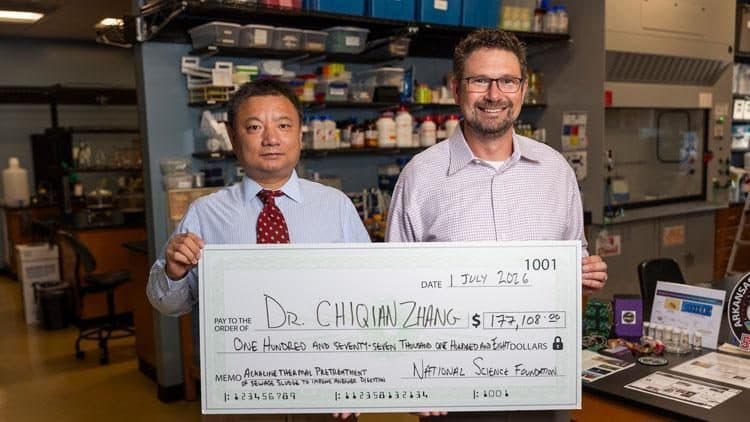
JONESBORO – Arkansas State University has received a $177,108 grant from the National Science Foundation (NSF) to support research aimed at advancing sustainable waste-to-energy technologies. The funding will enable Dr. Chiqian Zhang, an assistant professor of civil engineering, to explore more efficient and environmentally friendly methods for converting organic waste into renewable energy.
Dr. Zhang said he was surprised and excited when he learned his proposal was selected for funding, given the competitive nature of federal grants. “I felt a mixture of excitement, relief, and a little disbelief,” Zhang said. “The research plan is ambitious, and receiving the award means that all of the ideas and tasks I put on paper now have to become real experiments and real results.”
The project, titled *“ERI: Alkaline Thermal Pretreatment to Improve Anaerobic Digestion of Sewage Sludge through Mitigating Volatile Sulfur Compounds: Reactor Performance, Pathways, and Mechanisms,”* is funded through the NSF's ERI program. The research focuses on anaerobic digestion, a process that uses naturally occurring microorganisms to break down organic waste into methane, a renewable energy source.
One of the challenges in anaerobic digestion is the presence of sulfur in sewage sludge, which can produce volatile sulfur compounds (VSCs). These compounds hinder methane production, create unpleasant odors, and corrode equipment, reducing system efficiency. Zhang’s project seeks to address these challenges with a new pretreatment method that combines heat and calcium oxide (lime) to reduce sulfur compound formation before digestion begins.
“This approach has the potential to increase renewable methane production while extending the lifespan of wastewater treatment infrastructure and reducing environmental impacts,” said Zhang. His research combines laboratory reactor experiments, advanced chemical analyses, microbial studies, and predictive modeling to better understand the behavior of sulfur during the waste-to-energy process. The findings aim to inform the design of more efficient wastewater treatment systems for municipal and other organic waste sources.
Dr. Travis Marsico, A-State's vice provost for research, innovation, and discovery, commended Zhang’s efforts. “We are so proud of and excited for Dr. Zhang to be funded to conduct this important, applied research. This project exemplifies the diversity of innovative work that A-State faculty and students are pursuing,” Marsico said.
In addition to advancing research in environmental engineering, the project will provide hands-on opportunities for students and strengthen collaborations with local wastewater treatment facilities. Zhang emphasized the importance of involving students in research, saying, “The impact of a research project is not limited to the data and papers it produces. It also includes the students who gain experience from doing the research.”
Zhang expressed gratitude to colleagues at A-State and the university’s Research and Technology Transfer office for their support. He also encouraged other researchers to persevere through the challenges of securing funding. “Do not lose hope and keep trying,” he said. “Rejection is a normal part of academic life. Keep developing your ideas, because you never know when the good news will arrive.”
The two-year project began on July 1 and will run through June 30, 2028. It aligns with A-State’s commitment to fostering innovative engineering solutions that support sustainable energy production and environmental stewardship.