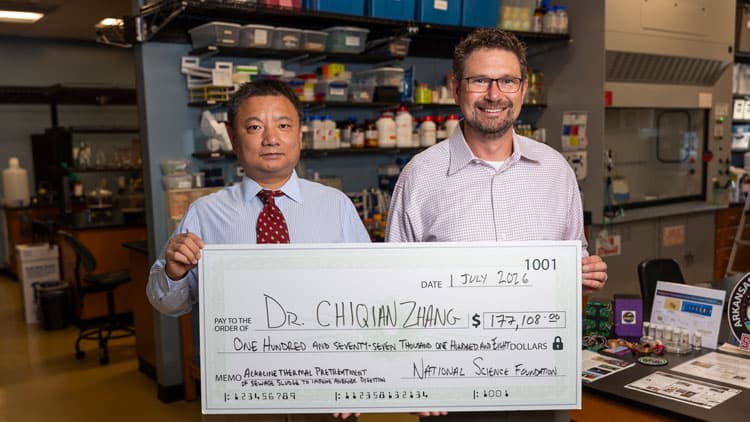
JONESBORO — Dr. Chiqian Zhang, an assistant professor of civil engineering at Arkansas State University, has been awarded $177,108 through the National Science Foundation’s Established Program to Stimulate Competitive Research (NSF EPSCoR). The grant will fund research on improving waste-to-energy systems to make them more efficient, environmentally friendly, and sustainable.
Zhang expressed both excitement and determination after learning his proposal had been selected. "I felt a mixture of excitement, relief, and a little disbelief. The research plan is ambitious, and receiving the award means that all of the ideas and tasks I put on paper now have to become real experiments and real results," Zhang said in a university statement.
His project focuses on enhancing anaerobic digestion, a biological process that transforms organic waste into renewable energy, typically in the form of methane. Current waste-to-energy systems face significant challenges, including the production of harmful sulfur-based compounds from sewage sludge. These compounds reduce methane output, generate unpleasant odors, and corrode treatment equipment, limiting system efficiency.
Zhang’s research explores a novel pre-treatment method that combines heat and calcium oxide—commonly known as lime—to curb the formation of these volatile sulfur compounds before the digestion process begins. The approach aims to improve methane yields while protecting infrastructure and reducing environmental impacts.
"We are so proud of and excited for Dr. Zhang to be funded to conduct this important, applied research that can improve how we process our waste," said Dr. Travis Marsico, vice provost for research, innovation, and discovery at A-State. Marsico emphasized how the project reflects the university’s growing commitment to meaningful and diverse research initiatives.
The two-year project, which began July 1, incorporates laboratory reactor experiments, chemical analyses, microbial studies, and predictive modeling. Researchers hope the findings will guide the design of more effective anaerobic digestion systems for use in municipal wastewater facilities and other organic waste sources. Zhang also plans to involve students in the research, offering hands-on experience in environmental engineering, renewable energy, and wastewater treatment.
"The award gives us the resources to pursue research that I believe is both scientifically interesting and practically meaningful," Zhang said, emphasizing the importance of the educational aspect of the work. "The impact of a research project is not limited to the data and papers it produces. It also includes the students who gain experience from doing the research."
The project will also strengthen collaborations with local wastewater treatment facilities, helping to translate research outcomes into practical applications. Zhang said he hopes his achievement encourages other early-career researchers to persevere in seeking grant funding. "Do not lose hope and keep trying. This is a challenging time for many researchers seeking federal and state support, and rejection is a normal part of academic life," he advised.
With the grant in place, A-State continues to enhance its efforts to develop innovative solutions for sustainable energy production and environmental management.