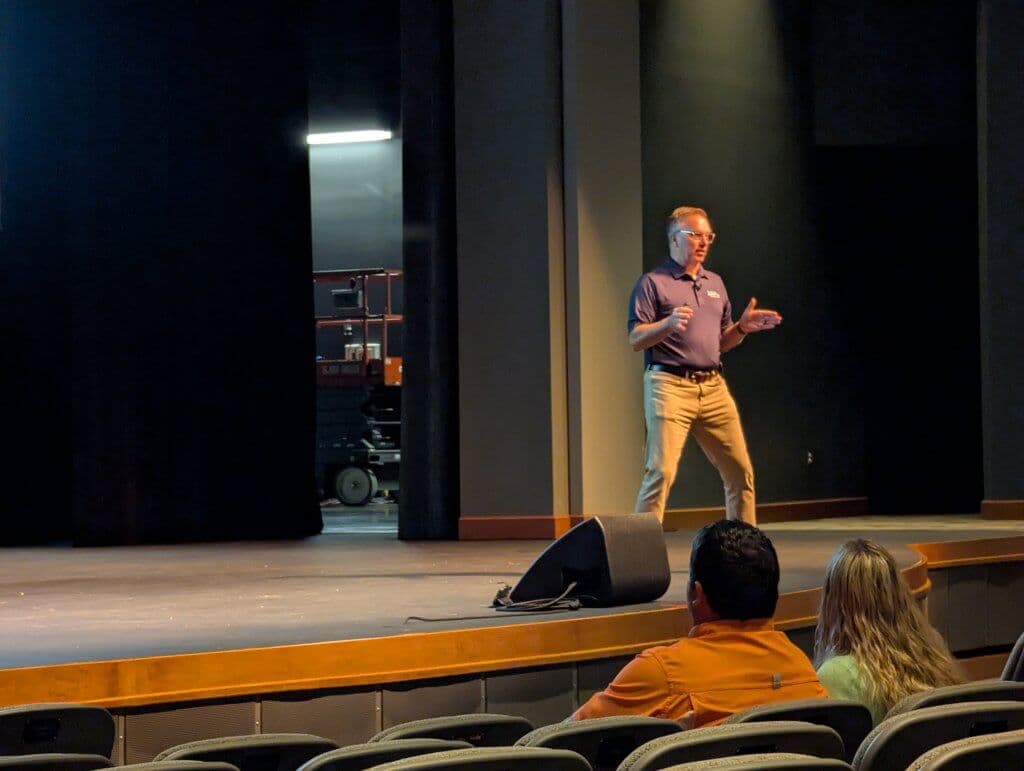
Dennis Gillan, executive director of the Half a Sorrow Foundation, shared his personal story of loss and resilience during a free event Saturday evening at the Vada Sheid Community Development Center in Mountain Home. The event, hosted by Baxter Health, followed the Run for Tomorrow 5K at Arkansas State University-Mountain Home and aimed to shine a light on suicide prevention.
Gillan, who lost two of his five siblings to suicide, candidly discussed what he has learned from his own struggles and his work in suicide prevention. Opening his talk titled “It’s a Tough Subject,” he acknowledged that discussing mental health and suicide can be uncomfortable but stressed its importance.
“Step in before they step out,” Gillan told the audience, referring to the need for timely intervention when someone shows signs of crisis. He shared his experience of being a college student when his brother Mark died by suicide after battling depression. Years later, his youngest brother, Matthew, also died by suicide, an event that motivated Gillan to reevaluate his choices and seek help.
Gillan emphasized the need to address stigma around mental health, especially seeking counseling. He recounted his own hesitance to admit he needed professional help, a hesitation he noted is diminishing among younger generations. “There’s no stigma in asking for help,” he said, urging anyone in distress to use available resources.
As part of his presentation, Gillan offered practical advice for identifying suicidal behavior, organizing warning signs into three categories: talk, behavior, and mood. He explained the danger signs associated with isolation, substance misuse, and sleep problems, as well as the importance of checking in with others when something feels wrong. “I’d rather you say something super embarrassing than lose someone to suicide,” he said.
Gillan praised community efforts in suicide prevention, such as the local suicide survivor outreach team funded by last year’s Run for Tomorrow. Modeled after an initiative in South Carolina, the team provides immediate support to families affected by suicide, offering resources and a listening ear. He also highlighted the impact of Baxter County’s initiatives in reducing incidents of veteran suicide.
While sharing his deeply personal experiences, Gillan offered hope to those in crisis and their support networks, emphasizing that recovery and thriving are possible even after significant loss. He shared an anecdote about a sunflower near his garage that continued to grow after being eaten by rabbits, calling it a reminder of resilience and life’s ability to bounce back. “Life isn’t all Skittles and unicorns,” he said. “You don’t give up.”
Gillan encouraged attendees to stop at resource tables after the event and thanked local organizers, including Jamie Leach and Summer Sasser, for their efforts in bringing the community together.
He closed his talk with a message of solidarity: “You are not alone. That’s why we’ve got to talk.”
Anyone in crisis can call or text 988 to reach the Suicide and Crisis Lifeline. Additional resources are available at local mental health providers or through national hotlines.