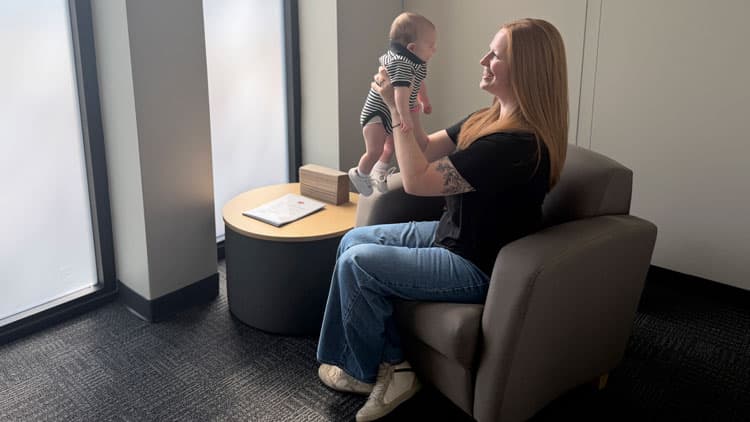
JONESBORO — Arkansas State University has introduced eight lactation rooms across its campus, providing nursing mothers with private spaces to pump or nurse. The initiative is aimed at supporting mothers balancing academic, professional, and family responsibilities.
Rachel Anderson, director of social media strategies, emphasized the importance of these spaces: “The need for these spaces really comes down to removing barriers for mothers who are trying to balance school, work, and family. Nursing and pumping are nonnegotiable, time-sensitive needs, and without a designated space, mothers are left trying to find somewhere private on their own, pumping or nursing in their car, or rearranging their day around leaving campus.”
Anderson, who became a mother for the second time in June, said creating these rooms was a personal and professional priority. “As I returned to work, I knew I would be relying on these spaces across campus. It made me think about how many other mothers at A-State, including students, faculty, staff, and visitors, are trying to navigate those same needs every day,” she said.
Dr. Tiffany Mosley, director of Institutional Integrity and Title IX, underscored the health benefits of these spaces for both mothers and their children. “A lactation room is a dedicated private space where nursing mothers can express their milk through pumping or feeding,” she explained. “It is especially useful for mothers to maintain their milk supply when away from their infant.”
Mosley also pointed out that providing these spaces demonstrates A-State’s commitment to fostering a supportive campus environment. “The significance of having a lactation space on campus allows mothers to maintain their milk supply while working or attending classes. It promotes academic success and employee retention. Without access to these spaces, mothers risk medical complications such as clogged ducts, mastitis, or pain and discomfort,” she said.
The lactation rooms feature locking doors, comfortable chairs, electrical outlets, and nearby access to water sources. They are located in high-traffic buildings frequently used by students, employees, and visitors. The newest addition, located in Centennial Bank Stadium near entrance W2, is aimed at accommodating nursing mothers attending athletic events.
“These private spaces are clean and secure, offering students, employees, and visitors the opportunity to continue breastfeeding while attending class, teaching, working, or participating in activities,” Mosley said.
Anderson added that the availability of these rooms reflects a broader effort to make the campus more family-friendly. “Whether someone needs a place to pump, care for their infant, change a diaper, or care for an older child, there is a growing number of spaces to take care of the basic needs of those with children. These aren’t hypothetical families we’re designing for. They’re our students, our employees, our visitors, our fans, and, in my case, my own family,” she said.
A-State officials hope to expand the number of lactation rooms in the future as part of their efforts to create an inclusive and supportive environment on campus.