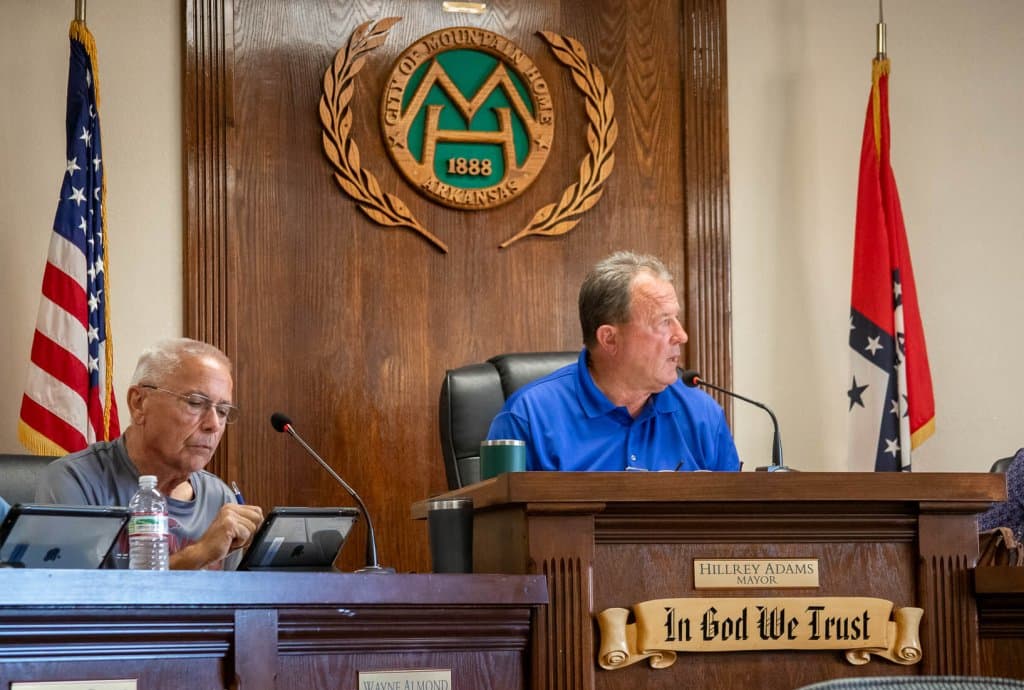
The Mountain Home City Council is set to discuss several notable items, including the destruction of city records, the purchase of smart water meters without competitive bidding, and revisions to local food truck regulations during its upcoming meeting. The meeting will take place on Thursday at 5 p.m. in the Council Chambers of the Municipal Building at 720 Hickory St. It is open to the public and will also be streamed by XL7-TV on Facebook and YouTube.
Under new business, Council members will address four main agenda items in addition to routine matters such as committee reports, bank reconciliations, and approval of minutes from the Aug. 20 meeting. Paul Neal is scheduled to provide a quarterly update on the Baxter Day Service Center to open the proceedings.
Among the key items, Mayor Hillrey Adams will present a resolution allowing the destruction of accounting and administrative records from various city departments, dating from 1999 to 2019. This resolution is based on Arkansas Code Annotated 14-59-114, which permits records to be destroyed after they have been retained for required periods and audited. Affected records include year-end reports, contracts, bids, payroll and bank documents, personnel files, business licenses, and building permits. If approved, the destruction process will involve oversight by a city employee and a Council member, with an affidavit documenting the process recorded in the meeting minutes.
The Council will also consider waiving competitive bidding requirements to approve the purchase of 96 Ally smart water meters for $55,861.15 from Core & Main of North Little Rock. Public Works Director Steve Hill will present a resolution explaining that Core & Main is the sole dealer for these meters and that public bidding would be impractical due to the proprietary nature and limited availability of the equipment. The proposal cites Arkansas Code Annotated 14-58-303, which allows such waivers in specific cases.
Another major agenda item is the second reading of an ordinance revising the city's regulations for mobile vendors, food trucks, and food truck courts. The proposal, which would replace two existing ordinances from 2020, has undergone public workshops and revisions since its introduction in July. Notable provisions include maintaining the current 30-day limit on how long a food truck may stay at one property, requiring a three-day absence before returning, prohibition of permanent structures, and clear distinctions between food trucks and mobile vendors. Food truck courts would be limited to Commercial zoning areas C-1, C-2, or C-2A, with restrictions on proximity to existing restaurants.
Other details in the ordinance include requirements for food trucks such as current licensing, mounted equipment, and operational readiness. License fees will remain $150 annually per truck and $50 annually per food truck court space. Noncompliance could result in misdemeanor charges with fines of up to $300 daily. If adopted after the required third reading, the revised ordinance would take effect on Oct. 4.
Before adjourning, the meeting will conclude with a public comment period.