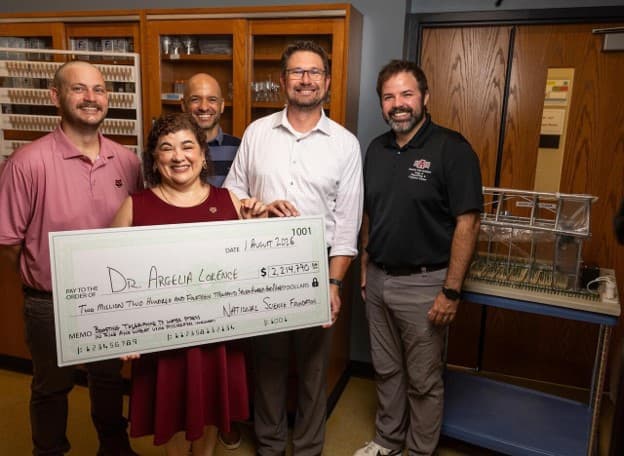
Arkansas State University (A-State) has been awarded $2.2 million by the National Science Foundation (NSF) to spearhead a multi-institutional research project aimed at improving drought tolerance in rice and wheat.
The initiative is part of a larger $6 million grant funded by the NSF’s Established Program to Stimulate Competitive Research (EPSCoR) Research Infrastructure Improvement Track-2 Focused EPSCoR Collaborations (RII-FEC) program. A-State will collaborate with teams from the University of Kansas, Kansas State University, and the University of Nebraska over the project’s four-year timeline.
Titled "Collaborative Research: FEC: Boosting Tolerance to Water Stress in Rice and Wheat Using Mycorrhizal Inoculants," the project will run from August 1, 2026, to July 31, 2030. Leading the research at A-State is Dr. Argelia Lorence, professor of metabolic engineering, alongside co-principal investigator Dr. Scott A. Mangan, an associate professor of ecology.
The research will explore the use of mycorrhizal inoculants—specialized fungi that assist plant roots in absorbing water and nutrients—to develop rice and wheat varieties better suited to withstand water stress. Both crops are vital staples worldwide, and drought conditions exacerbated by climate change have threatened their production in recent years.
Dr. Lorence emphasized the importance of the research, highlighting its potential to not only secure crop yields but also contribute to global food security efforts amid increasingly severe climate challenges.
This project places A-State at the forefront of agricultural innovation, joining forces with top academic institutions across three states to address urgent environmental and agricultural concerns.