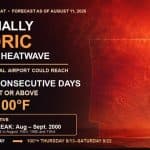
The National Weather Service (NWS) in North Little Rock is warning that Arkansas could experience one of its most extreme heatwaves in state history, potentially rivaling those of 1980, 2011, and 2012. Alongside the record-breaking heat, a flash drought is likely to develop, as little to no rainfall is expected through late August.
According to a report from the NWS on Tuesday afternoon, temperatures in Northern Arkansas will climb into the upper 90s during the workweek before exceeding 100 degrees daily starting this weekend. Heat index values are projected to range from 105 to 110 degrees. Overnight lows in the region will stay in the mid-70s but could rise close to 80 degrees, providing little overnight relief. The sustained intensity of the heatwave, coupled with minimal cooling at night, increases the risk of heat-related illnesses, particularly among vulnerable populations and those engaged in outdoor activities.
This extreme weather poses heightened risks for student-athletes returning to fall sports practices, as well as for residents conducting strenuous activities outdoors. The NWS has urged caution, emphasizing the importance of staying hydrated, limiting outdoor activity, and monitoring symptoms of heat exhaustion and heat stroke.
The Capital City is projected to endure at least 10 consecutive days with temperatures exceeding 100 degrees at Little Rock Airport, starting Thursday. If predictions hold, it would mark the longest such stretch since August to September of 2000. Similar heatwaves were recorded in 1983, 1980, and 1954.
Drought conditions, which had recently improved across the Twin Lakes region, are set to deteriorate once more. Data from the Climate Prediction Center highlights the likelihood of a rapid-onset drought, or flash drought, caused by below-average rainfall combined with abnormally high temperatures, winds, and solar radiation.
Although no burn bans have been issued and the wildfire threat remains low, the Arkansas Forestry Division is monitoring conditions closely as droughts can quickly exacerbate fire risks.
To stay safe during this period of extreme heat, the NWS advises wearing lightweight clothing, seeking air-conditioned spaces, and scheduling any outdoor tasks during the cooler early morning or evening hours. Individuals are encouraged to check on neighbors and relatives, especially those at greater risk for heat exposure.
This week's heatwave adds to a summer of weather extremes in the region, again underscoring how sustained high temperatures without overnight relief can adversely affect Arkansas communities.