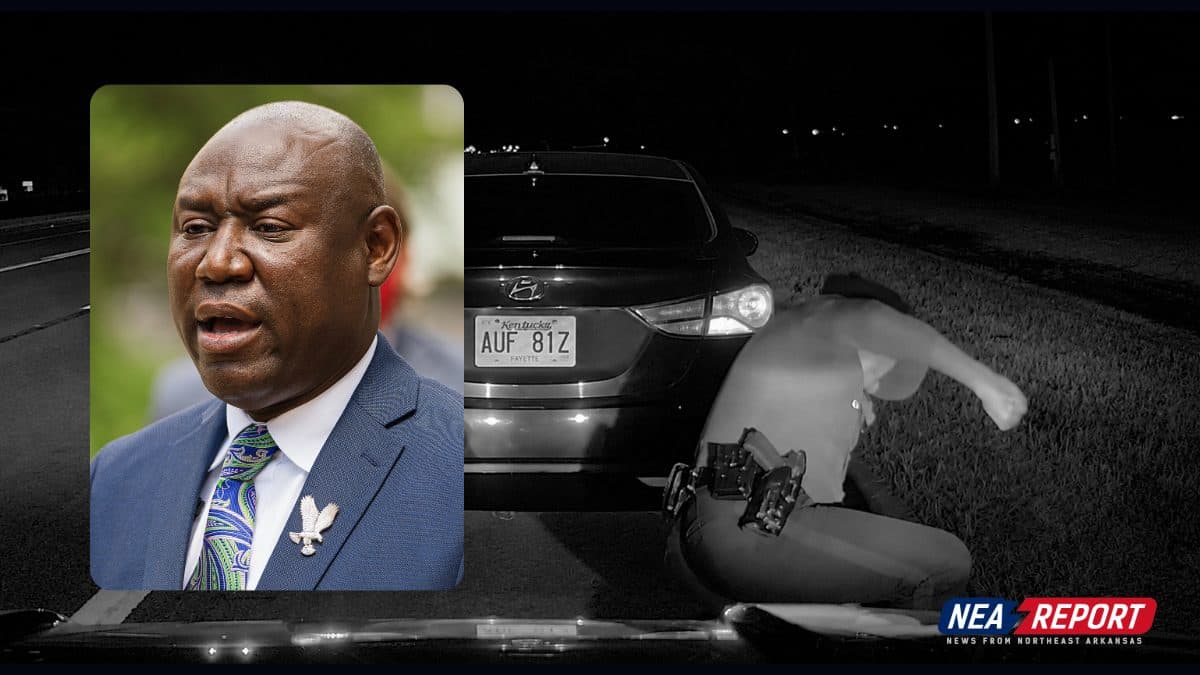
JONESBORO, Ark. — Alisa Hackett, an 18-year-old woman involved in a controversial traffic stop with an Arkansas State Police trooper on Aug. 1, has retained nationally recognized civil rights attorney Ben Crump. The announcement came Monday afternoon, just hours after Hackett’s initial attorney, Luther Sutter, filed a federal civil rights lawsuit on her behalf.
The lawsuit, filed in the Jonesboro Division of the U.S. District Court for the Eastern District of Arkansas, names Trooper Moisses Arellano in his individual capacity. It alleges violations of Hackett’s First and Fourth Amendment rights under 42 U.S.C. § 1983, including claims of excessive force and First Amendment retaliation.
Hackett terminated Sutter’s representation shortly after the complaint was filed. "I wish them luck, and she’s entitled to the lawyer of her choice," Sutter told NEA Report.
Crump, renowned for representing the families of Trayvon Martin, Michael Brown, and George Floyd, among other high-profile cases, has called for Arkansas State Police to investigate Arellano’s actions during the traffic stop. According to Crump, the trooper’s own report confirms that he took Hackett to the ground and delivered a closed-fist punch to her face after she allegedly resisted his attempt to handcuff her. Crump further urged the agency to release any prior use-of-force reports involving Arellano and to make the investigation’s findings publicly available.
Arkansas State Police spokesperson Cindy Murphy stated Monday that no records were yet available concerning disciplinary actions against Arellano. "We do not confirm Office of Professional Standards investigations until and unless an OPS review results in the suspension or termination of an employee," Murphy wrote in response to a Freedom of Information Act request by NEA Report.
The August 1 incident reportedly began when Arellano stopped Hackett for speeding—clocking her at 71 mph in a 60 mph zone—and escalated when Hackett allegedly became argumentative. Arellano’s report claims Hackett threw a clipboard toward him and resisted arrest, leading him to use force. Dashcam footage of the incident, first obtained by NEA Report, appears to show Hackett crying out for help and asking to call her mother as the trooper uses force. According to Arellano’s report, he warned Hackett with profanity and threatened further strikes if she did not comply.
Hackett’s lawsuit contends that Arellano’s actions were punitive and retaliatory, violating her rights to free speech and protection from unreasonable force. The complaint asserts that Hackett’s critical remarks questioning the purpose of the stop and the officer’s actions were protected speech under the First Amendment. Additionally, it argues that no reasonable officer would believe that punching a nonviolent individual constituted appropriate action, negating Arellano’s qualified immunity defense under existing law.
Hackett is seeking compensatory and punitive damages, as well as attorney’s fees, expert costs, and additional expenses, and she has requested a jury trial. The lawsuit does not name Arkansas State Police or the state as defendants.
Mississippi County jail records show Hackett was booked early Aug. 2 on charges of improper tag display, violating vehicle lamp restrictions, not wearing a seat belt, possession of alcohol by a minor, and refusal to submit to arrest. Those charges remain pending.
Crump’s involvement adds heightened visibility to the case, which raises broader questions about police use of force during routine traffic stops. As Hackett contests her charges and pursues her civil lawsuit, the legal and public scrutiny surrounding Arellano’s conduct continues to grow.
All suspects are presumed innocent until proven guilty in a court of law, and all civil allegations remain unproven unless established in the judicial process.